

The Lebanese Civil War According to Those Who Survived It — and Those Who Sanitise It
When Selective Memory Becomes “Scholarship”
Taghrid Al-Mawed
Original article date May 04, 2026
Certain commentators—including academics—routinely describe the Lebanese Civil War as if neutral, but actually use selective framing to erase context, isolate episodes, and shift blame, particularly to delegitimise Palestinians. This use of selective memory shapes public understanding and politics.
This pattern is starkly illustrated by a recent social media exchange that I will discuss below.
My Post — and Why It Matters
My original post was a retweet of someone’s death, not an argument. It was testimony. I wrote:
“I grew up in Lebanon hearing, in graphic detail, what his group did to Palestinian and Lebanese women. Two of my own aunties were seconds away from being raped and slaughtered by them. They survived by sheer miracle l, but the terror they carried never left our family.
(2) Taghrid Al-Mawed تغريد الموعد on X: “I grew up in Lebanon hearing, in graphic detail, what his group did to Palestinian and Lebanese women. Two of my own aunties were seconds away from being raped and slaughtered by them. They survived by sheer miracle l, but the terror they carried never left our family. This” / X
The man whose death I shared was not a random figure. He was a public actor who participated in violence against both Lebanese and Palestinian civilians. His actions are documented. Families like mine lived with the consequences.
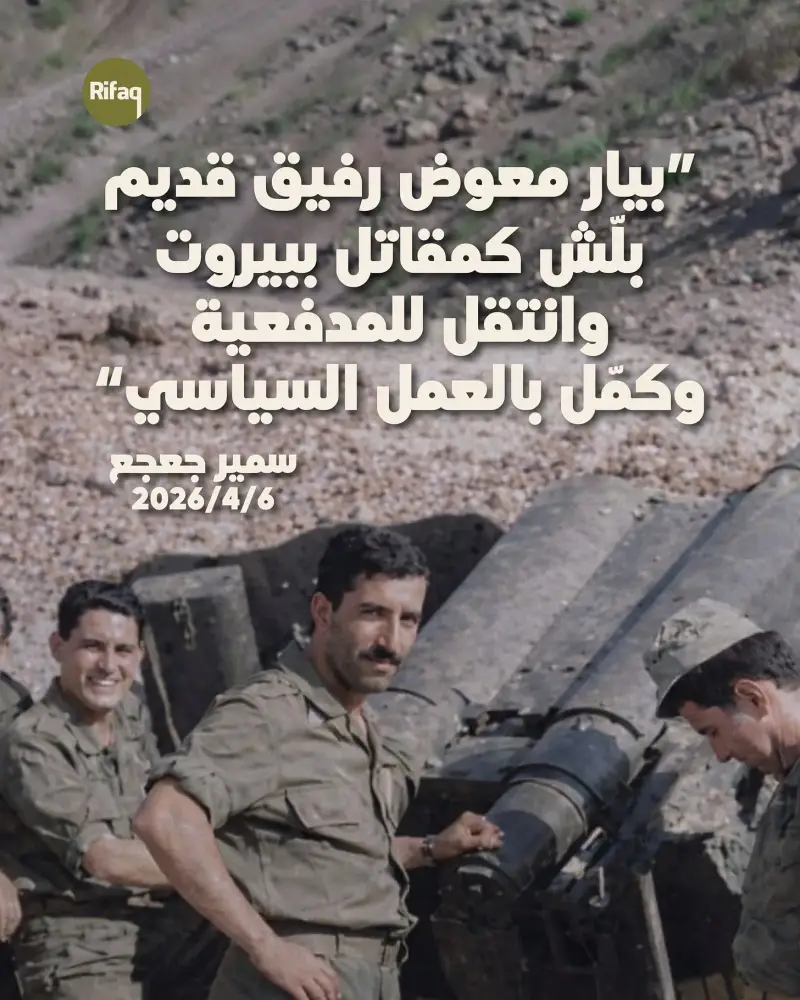
The poster translation
“Pierre Moawad is an old comrade who started as a fighter in Beirut, moved to artillery, and completed his journey with political work.”
War criminal Samir Geagea, 6/4/ 2026
And the historical irony is impossible to ignore:
The same foreign political forces that supported his militia during the war later not only bombed him, but he was killed with his wife, and left two children behind.
My post aimed to expose how selective historical narration serves political agendas and perpetuates violence by enabling impunity that passes from generation to generation.
It was not an attempt to “exploit” anyone’s death.
It was an attempt to contextualize it.
When Academic Titles Become Shields for Political Accounts
The professor who responded to my post introduced himself with full institutional authority:
Hicham Bou Nassif, Weinberg Associate Professor of IR and Middle East, and George R. Roberts Fellow at
Claremont McKenna College http://www.claremontmckenna.edu
His titles presented a selective narrative as objective scholarship, serving as a defensive shield for a sectarian perspective.
These credentials serve as a shield legitimising a narrow, sectarian interpretation as objective scholarship and showing how academic authority can force political accounts under the guise of neutrality.
And when I looked at his recently published writing, the pattern became even clearer. In a recent article
Who Killed Pierre Moawad and His Wife? - In SyriacPress, he frames Lebanese political violence through a narrow, sectarian lens that casts one community as perpetual victims and others as perpetual threats. The structure is the same: simplify the conflict, isolate one actor, erase the militias, foreign involvement, and changing alliances, and present a deeply political narrative as if it were a neutral analysis.
This approach is consistent with his response to my post and his published writing.
He consistently applies this method academically and online.
This raises an unavoidable question about academic responsibility:
What does it mean when a university hires someone who publicly presents one‑sided political stories as historical fact?
Claremont McKenna College’s policies reflect its stance on academic scholars. Still, the real issue is whether it promotes multi-perspective, rigorous teaching or allows the reduction of the Lebanese Civil War to a single accusatory narrative—hence shaping which histories are emphasized in the classroom.
When an academic uses their platform to erase context, dismiss survivor testimony, and reproduce sectarian memory as “history,” it becomes legitimate to ask:
How does this correspond to the standards of academic integrity?
What safeguards ensure students are taught sophistication rather than political mythology?
How do institutions evaluate the public scholarship of their faculty, especially when it concerns regions defined by trauma and contested memory?
These are not personal questions.
They are structural ones — about the ethics of representation, the responsibilities of scholars, and the role of universities in forming public understanding of conflict.
How the Professor Responded — and What It Reveals
Rather than engage my argument, the professor redirected the conversation to promote a sectarian narrative, reducing the entire Civil War to one storyline: ‘the Palestinians caused it.’ This highlights how selective narration distorts history.
This is not how any serious historian describes the conflict.
Lebanon’s Civil War was a multi‑faction struggle involving:
right‑wing Christian militias
leftist Lebanese parties
Palestinian factions
Syrian forces
Israeli forces
later, Amal, and others
Every major faction committed violence.
Every major faction displaced civilians.
To isolate Palestinian factions as the cause is not an analysis — it is sectarian storytelling.
What His Narrative Erased
His response omitted:
The zionist entity’s occupation of South Lebanon
massacres of Palestinian civilians, such as Tel al‑Za‘tar and Sabra & Shatila
the statelessness and militarisation imposed on Palestinian camps
alliances between Lebanese militias and foreign armies
The decades in which Palestinians in Lebanon were denied basic rights
History loses meaning without context; context is essential to avoid history that serves predetermined, political ends rather than understanding the reality of events.
It is a curated narrative designed to produce a predetermined conclusion.
I have written about this pattern before.
In a previous article, I documented the early militarisation of the Christian militias, their pre‑1975 clashes with Palestinian camps, their foreign alliances, and their role in some of the war’s most notorious massacres. These details are not controversial among historians; they are part of the established scholarship on the conflict.
For readers who want deeper historical grounding, that analysis is available here:
buymeacoffee.com/taghridalmawed/the-history-they-beg-you-not-read
or
https://substack.com/@1taghrid/p-194061023
The History They Beg You Not to Read
Taghrid Al-Mawed
·
13 Apr
The History They Beg You Not to Read
The History They Beg You Not to Read: The pro zionist entity Christian Militia in Lebanon
Read full story
The fact that these well‑documented events disappear entirely from his narrative is not accidental.
This omission is structural and political.
It is political, reinforcing selective memory.
For this reason, challenging selective memory is very important: it prevents the weaponization of the past to shape present agendas and guarantees a more honest public discourse.
Projection as Argument
He accused me of “exploiting deaths” — while resurrecting massacres from the 1970s and 1980s to attack a Palestinian woman in 2026.
This is a projection.
My post was about present‑day violence and its continuity.
His reply was about silencing that conversation.
The Trope of “Guests Who Betrayed Lebanon”
Another familiar theme appeared: the idea that Palestinians were “guests” who “turned against” Lebanon. This framing ignores:
Palestinians arrived as refugees fleeing ethnic cleansing.
Lebanon’s political system was fractured long before its arrival.
Many Lebanese factions invited, armed, or coordinated with Palestinian groups.
The war was not caused by one community.
This trope has long been used to justify discriminatory policies toward Palestinians in Lebanon.
When Argument Ends, Insults Begin
He concluded with personal accusations — “extremist,” “shameful,” “morally indefensible.”
This is not academic language.
It is political hostility.
When someone abandons evidence in favour of insult, it signals that the argument has reached its limit.
Conclusion: When Memory Becomes a Combat Zone
This exchange exposes something considerably larger than a disagreement on social media. It reveals how survivors’ testimonies are dismissed when they disrupt dominant narratives, how Palestinian experiences are minimised or erased, how academic authority can be used to reinforce political identities, and how the Lebanese Civil War continues to be fought today — not through militias, but through competing memories.
This case illustrates how historical memory becomes a battlefield: survivors’ testimonies are suppressed, Palestinian experiences minimised, and academic authority used to reinforce political identities. The Lebanese Civil War cannot be viewed through a single lens—its complexity resists reduction to sectarian storytelling, which serves present-day agendas rather than historical facts.
True historiography must embrace complexity, acknowledge all victims, and resist manipulation of the past to silence or elevate certain voices. The debate over memory is a fight for whose suffering and humanity count, a challenge to academia and public discussion.
His supporters and followers attacked me and wished me death, and others wished the rape of my mother and me. I saved some images, and I will share them with you.
Another hostile reply to my post. The man in the image was involved in the Sabra and Shatila crimes.
Final note
I’m always open to giving talks, lectures, or seminars for anyone who genuinely wants to understand the culture, politics, and lived history of the Levant. And if there’s a topic I can’t cover myself, I’m more than happy to bring in people who were part of the history — people with real knowledge, real experience, and real memory.
If you want the truth, start with the people who lived it.
Your contribution to my work and support in keeping me going would be greatly appreciated.
Taghrid Al-Mawed. Writing from Wales, but with my soul in Palestine
Share widely — but please credit my writing
Add comment
Comments